A Channel, Not the Source
It reminds those in recovery that they are "channels" for a Higher Power, rather than trying to control everything themselves.
Lord, make me a channel of Thy peace;
that where there is hatred, I may bring love;
that where there is wrong, I may bring the spirit of forgiveness;
that where there is discord, I may bring harmony;
that where there is error, I may bring truth;
that where there is doubt, I may bring faith;
that where there is despair, I may bring hope;
that where there are shadows, I may bring light;
that where there is sadness, I may bring joy.
Lord, grant that I may seek rather
to comfort, than to be comforted;
to understand, than to be understood;
to love, than to be loved.
For it is by self-forgetting, that one finds.
It is by forgiving, that one is forgiven.
It is by dying, that one awakens to Eternal Life.
Amen.
In the 12-step tradition, this prayer is specifically highlighted in Step 11 of Twelve Steps and Twelve Traditions, where Bill W. built the Step Eleven discussion around it as a model for meditation and urged readers to “reread this prayer several times very slowly.” That is why AA members know it as the 11th Step Prayer, and why countless Step Eleven readings and meetings turn to it. Whether you look for the St. Francis Prayer or the 11th Step Prayer, the text, audio and PDF above are the same prayer, in the “channel of Thy peace” wording the fellowship uses.
Countless AA meetings and Step Eleven readings turn to this prayer and its call to be “a channel of Thy peace.” Yet its history holds a surprise: the saint whose name it carries almost certainly never wrote a word of it.
Despite its title, this prayer was not written by St. Francis of Assisi (c. 1181–1226), and no one attributed it to him for seven centuries. It is entirely absent from his authenticated writings. Its inward focus on “I” and “me” — without ever using the words “God” or “Jesus” — is unlike anything Francis actually composed. The definitive study is by French historian Christian Renoux, whose 2001 book La prière pour la paix attribuée à saint François: une énigme à résoudre (“The Peace Prayer Attributed to St. Francis: A Riddle to Be Solved”) traced the text and showed it “appeared, anonymously, in 1912, in France, and has been wrongly attributed to saint Francis around 1925.” None of this makes the prayer less worthy — only younger than its legend.
The earliest known appearance is in the December 1912 issue of La Clochette (“The Little Bell”), a small devotional magazine of a Paris Catholic association, La Ligue de la Sainte-Messe. There it ran anonymously under the plain title “Belle prière à faire pendant la messe” (“A Beautiful Prayer to Say During Mass”). Renoux concluded the author was likely the magazine’s founding editor, Father Esther Bouquerel (1855–1923). In 1915, French Marquis Stanislas de La Rochethulon sent it to Pope Benedict XV, and on 20 January 1916 an Italian translation ran on the front page of the Vatican newspaper L’Osservatore Romano — under the heading “The prayers of Souvenir Normand for peace” — before La Croix reprinted it in French on 28 January 1916, driving its wide circulation as a prayer for peace amid World War I. Around 1918, Franciscan Father Étienne Benoît printed it on the back of a mass-produced holy card depicting St. Francis, still without naming him as author. People who held the card simply assumed the face on the front belonged to the words on the back.
The prayer was first explicitly attributed to Francis in 1927 by a French Protestant movement, Les Chevaliers du Prince de la Paix (The Knights of the Prince of Peace), founded by Étienne Bach. According to Renoux, its first known English translation appeared in 1936 in Living Courageously by Kirby Page, a Disciples of Christ minister, who attributed it to St. Francis. Alcoholics Anonymous adopted the prayer in the 1953 Twelve Steps and Twelve Traditions — in the “channel of Thy peace” wording the fellowship still uses — where Bill W. built the Step Eleven discussion around it as a model for meditation, urging readers to “reread this prayer several times very slowly.” Notably, the book is careful about authorship: it presents the prayer as words to meditate on rather than claiming Francis as its author. For a fellowship built on humility and service, it is a natural fit — whoever first wrote it.
Researched and written by the SoberHub team · Last reviewed
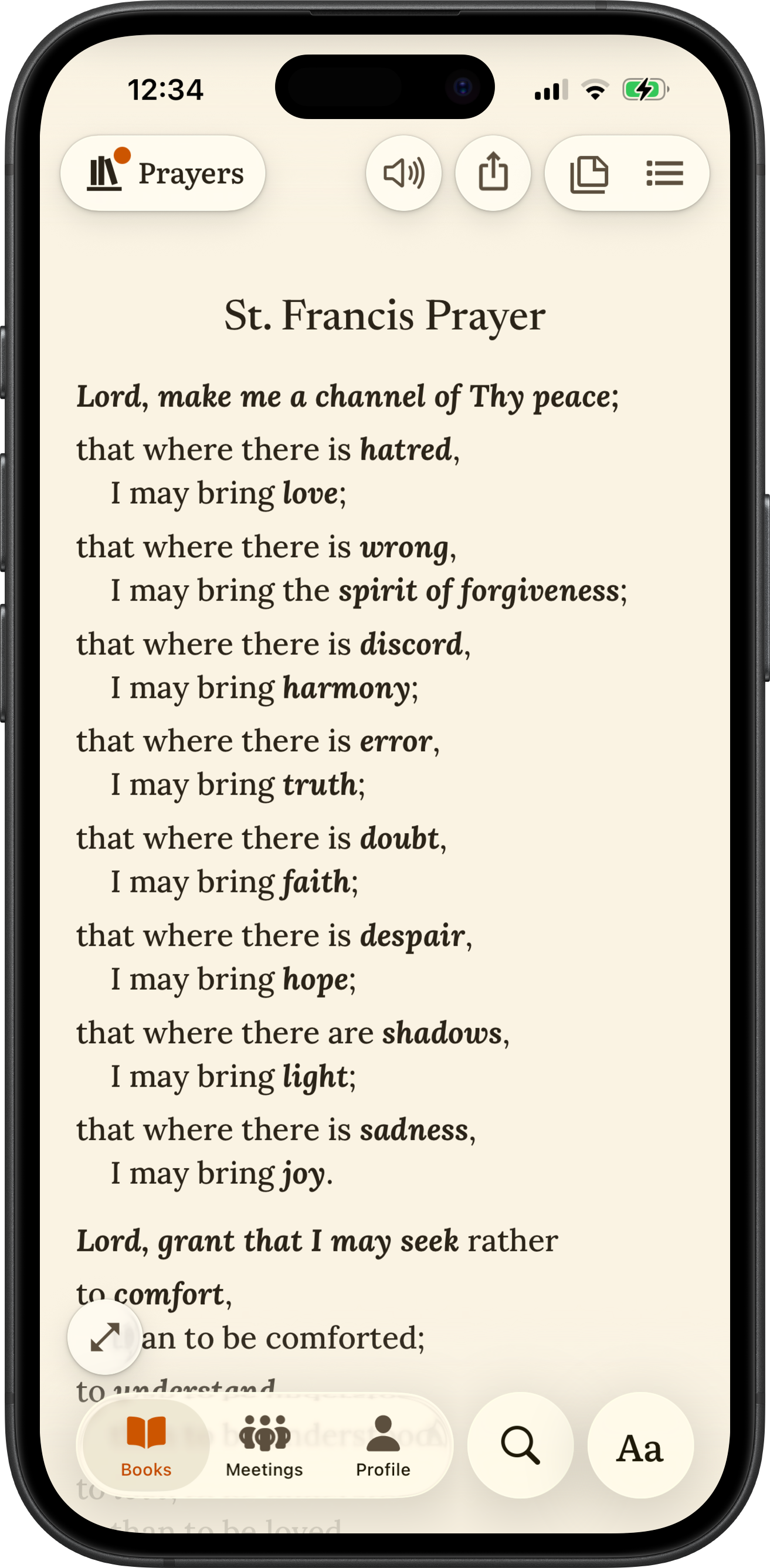
Take this prayer, the Big Book, and your daily recovery tools wherever you go.


Free, no-ads on the SoberHub App.
About this prayer
In recovery, the prayer serves as a practical guide for moving from "self-will run riot" to a life of spiritual service.
It reminds those in recovery that they are "channels" for a Higher Power, rather than trying to control everything themselves.
The line "it is by self-forgetting that one finds" is a direct answer to the "bondage of self" named in the Third Step Prayer.
The prayer names hatred, discord, and despair, and asks to answer them with love, harmony, and hope.