The "Our" in Recovery
Starting with "Our Father" immediately reinforces the principle of fellowship—that no one has to recover alone.
Our Father, who art in heaven,
hallowed be thy name;
Thy kingdom come,
thy will be done
on earth as it is in heaven.
Give us this day our daily bread,
and forgive us our trespasses,
as we forgive those who trespass against us.
And lead us not into temptation,
but deliver us from evil.
For thine is the kingdom,
and the power,
and the glory,
for ever and ever.
Amen.
Many 12-step meetings close with the Lord’s Prayer, hands joined in a circle. Here is where those words actually come from.
The Lord’s Prayer appears twice in the New Testament: a longer version in Matthew 6:9–13, set inside the Sermon on the Mount, and a shorter one in Luke 11:2–4, where Jesus gives it in response to a disciple asking, “Lord, teach us to pray.” Matthew’s is the fuller form most people recite; Luke’s is briefer, dropping lines like “your will be done.” A detailed comparison is offered by Bible Odyssey, a site run by the Society of Biblical Literature.
Jesus almost certainly taught in Aramaic, the everyday language of first-century Galilee, but no Aramaic original of the prayer survives. Both Gospels were written in Koine Greek, the common language of the eastern Roman world, so the prayer as we actually have it is a Greek text from the start.
The oldest known copy of the Lord’s Prayer is in Papyrus 75 (also called Bodmer Papyrus XIV–XV, or the Hanna Papyrus “Mater Verbi”), a Greek codex dated to about 175–225 CE that preserves Luke’s version. It was donated to the Vatican Library in 2007. Matthew’s fuller version survives in the great fourth-century codices — Codex Sinaiticus, held mostly at the British Library, and Codex Vaticanus. Sinaiticus, handwritten around 1,600 years ago, is the oldest complete New Testament in existence.
The English wording most meetings use came down a long chain: Greek to Latin, then Latin to English. St. Jerome’s Latin Vulgate gave Western Christianity the “Pater Noster” (“Our Father”). In 1526, William Tyndale printed the first English New Testament translated directly from the Greek, and at Matthew 6:12 he chose the word “trespasses.” English prayer books from 1549 onward kept that wording, which is why so many still recite “forgive us our trespasses.” The 1611 King James Version went the other way — “And forgive us our debts, as we forgive our debtors” — so the familiar spoken wording follows the older prayer-book tradition rather than the KJV.
The other common difference is the ending. Many Protestants add the doxology — “For thine is the kingdom, and the power, and the glory, forever” — but textual scholars such as Bruce Metzger concluded it was a later addition by the early church, not part of the earliest manuscripts of Matthew. It is absent from Codex Sinaiticus and Codex Vaticanus, and Luke never had it. A short form does appear very early, in the Didache (circa 100–150 CE), which gives a version of the prayer close to Matthew’s, followed by the instruction to “pray like this three times a day.”
The prayer entered recovery through the Oxford Group, the Christian fellowship where AA’s founders got their start in the mid-1930s. According to Alcoholics Anonymous’s own literature, the custom reaches back to the Fellowship’s earliest days — a time when AA had no literature of its own and did not yet even have a name. AA’s archivist has recorded that oldtimers’ memories differ as to exactly when the Lord’s Prayer was first used, but members who came to the Fellowship in 1938 and 1939 recalled it being said at meetings then. Co-founder Bill W. thought the practice might have been a carry-over from the custom of AA’s forerunner, the Oxford Group, but, as the archivist put it, he “was never really sure.” Today each group is autonomous, so some close with the Lord’s Prayer, some with the Serenity Prayer, and some with a moment of silence.
Researched and written by the SoberHub team · Last reviewed
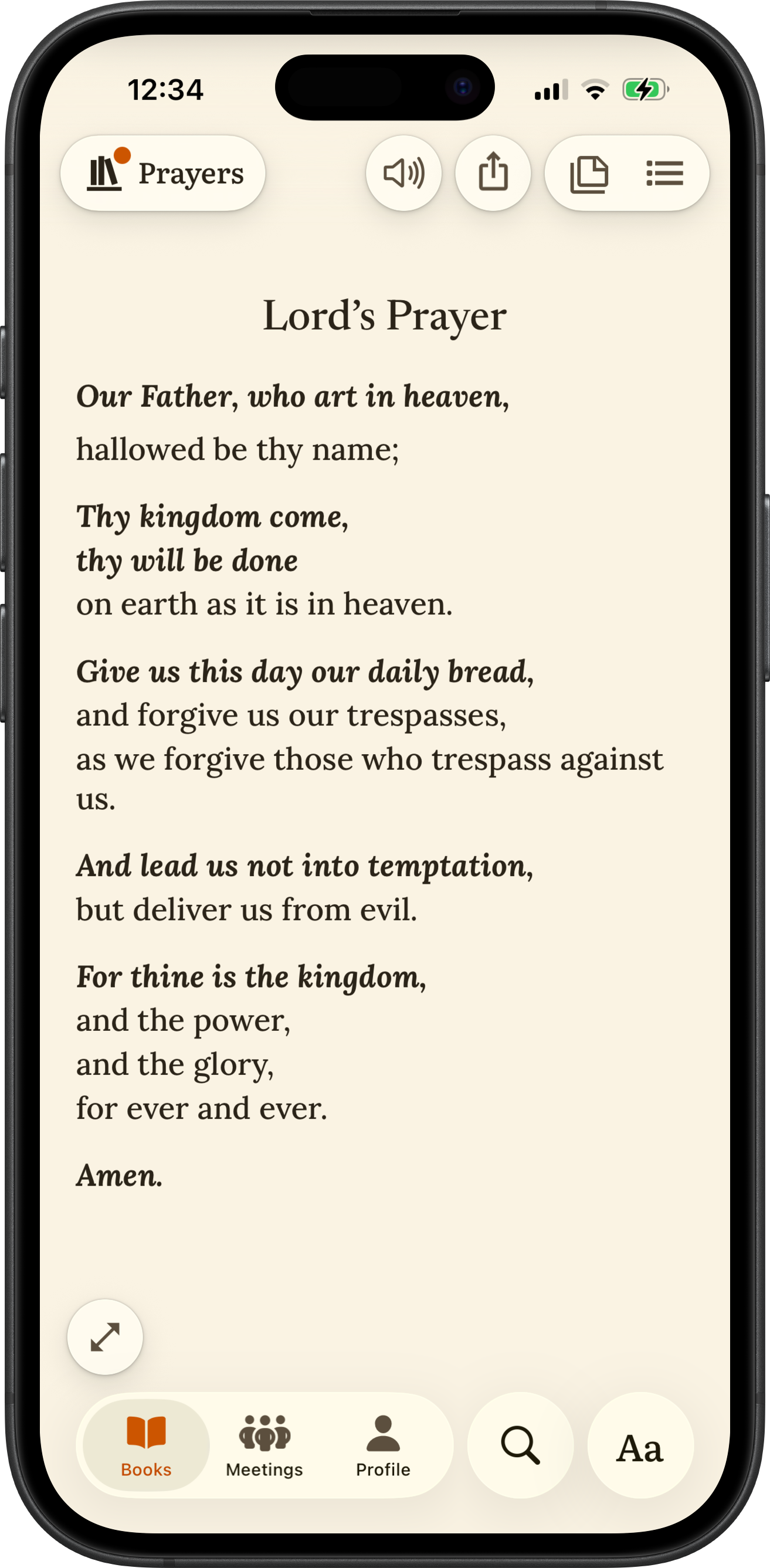
Access the Lord’s Prayer, the Big Book, and your daily sobriety tools all in one place. Join the global community on SoberHub.


Free, no-ads on the SoberHub App.
About this prayer
While the Lord’s Prayer is a central Christian prayer, it has been a staple of the recovery community since the 1930s. In the early days of Alcoholics Anonymous, before the Fellowship had its own literature, this prayer was frequently used to close meetings and seek spiritual guidance.
Starting with "Our Father" immediately reinforces the principle of fellowship—that no one has to recover alone.
The line "Give us this day our daily bread" aligns with the "one day at a time" philosophy, focusing on spiritual maintenance for the next 24 hours.
By asking for forgiveness "as we forgive those who trespass against us," the prayer serves as a daily reminder of Step 8 and Step 9—the importance of clearing away resentments to stay sober.