Abandon
En la récitant, la personne reconnaît que sa « volonté propre » a causé sa souffrance et qu'une nouvelle direction est nécessaire.
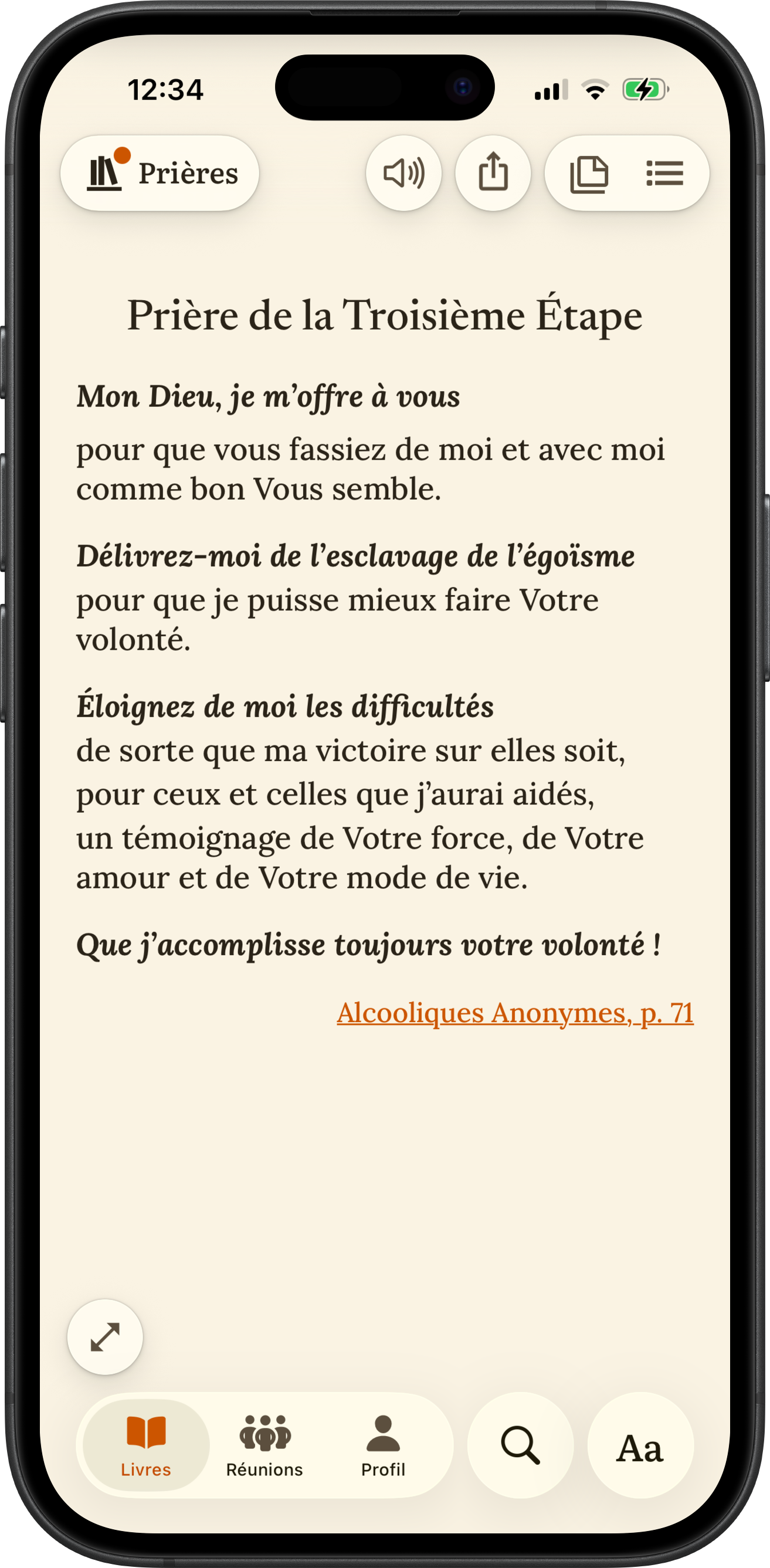
Mon Dieu, je m’offre à vous
pour que vous fassiez de moi et avec moi comme bon Vous semble.
Délivrez-moi de l’esclavage de l’égoïsme
pour que je puisse mieux faire Votre volonté.
Éloignez de moi les difficultés
de sorte que ma victoire sur elles soit,
pour ceux et celles que j’aurai aidés,
un témoignage de Votre force, de Votre amour et de Votre mode de vie.
Que j’accomplisse toujours votre volonté !
Récitée chaque jour dans des réunions du monde entier, la Prière de la Troisième Étape n’a jamais été imprimée comme une prière autonome. Voici d’où viennent ces mots.
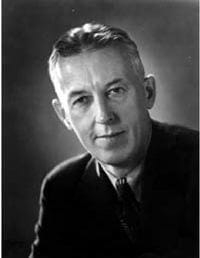
La prière est apparue pour la première fois dans Alcoholics Anonymous — le « Gros Livre », publié en avril 1939 — au chapitre 5, « Notre méthode », dans le passage consacré à la Troisième Étape. Elle apparaît sans titre, au milieu du récit : « Plusieurs d’entre nous ont adressé à notre Créateur, tel que nous Le concevions, la prière suivante », lit-on, et le livre ajoute aussitôt que les mots sont facultatifs dès lors que l’idée est exprimée. Le chapitre a été écrit par le cofondateur Bill Wilson, et les Douze Étapes qui en forment le cœur sont venues rapidement. Selon son propre récit, il les a rédigées un soir, à la fin de 1938, au lit au 182 Clinton Street à Brooklyn, avec un crayon et un bloc de papier : « It took perhaps half an hour. The words kept right on coming. »
Wilson et le Dr Bob ont tous deux trouvé la sobriété au sein du Groupe d’Oxford, un mouvement évangélique fondé par le pasteur luthérien Frank Buchman, où adhérer signifiait faire « un abandon » : s’agenouiller et remettre sa volonté et sa vie à Dieu. Wilson n’a jamais caché cette dette : les premiers AA, écrit-il, ont tiré l’inventaire personnel, l’aveu des défauts de caractère, la réparation et le travail auprès d’autres alcooliques “straight from the Oxford Groups and directly from Sam Shoemaker … and from nowhere else” (Alcoholics Anonymous Comes of Age, p. 39). L’antécédent documenté est celui de V. C. Kitchen, un publicitaire new-yorkais sobre au sein du Groupe. Ses mémoires de 1934, I Was a Pagan, reconstituent sa propre prière d’abandon — « I surrender Thee my entire life, O God » — demandant à Dieu de prendre toute sa vie et de la conduire selon Son plan. Cinq ans avant le Gros Livre, la forme de la prière était déjà sur la page.
Les empreintes du Groupe subsistent dans les brouillons du Gros Livre. Dans le manuscrit de 1938 précédant la publication — diffusé auprès des amis des fondateurs avant l’impression — le passage prend la forme d’un ordre : « Get down upon your knees and say to your Maker », suivi de la prière mot pour mot telle qu’elle se lit aujourd’hui. Avant publication, l’agenouillement a disparu et l’injonction « you » s’est adoucie en « we », celui de la fraternité — le récit de Wilson rappelle que ses amis avaient objecté ce soir-là que le brouillon s’appuyait trop lourdement sur Dieu et sur l’idée de mettre les ivrognes à genoux. La prière elle-même n’a pas été touchée : telle qu’elle figurait dans le brouillon de 1938, elle se lit encore aujourd’hui — à la page 71 de l’édition française.
Certains articles affirment que le véritable auteur de la prière était Harold Hill, un membre des AA dont le livre de 1976, How to Be a Winner, contient une prière semblable. Le manuscrit tranche : le texte intégral circulait dès 1938, des décennies avant le livre de Hill ; la prose du Gros Livre, non signée par choix, attire simplement les prétendants. Le numéro de page, lui, a à peine bougé : « Notre méthode » occupe les pages 65 à 80 dans les éditions actuelles, et les AA ont laissé le texte de rétablissement “left largely untouched” à travers les deuxième (1955), troisième (1976) et quatrième éditions.
Recherche et rédaction : équipe SoberHub · Dernière révision :
Vis le Big Book et toutes les prières essentielles des AA partout. Suis ta sobriété et connecte-toi avec la communauté.


Gratuit, sans publicité sur l'app SoberHub.
À propos de cette prière
Dans le cheminement des douze étapes, l'Étape 3 est l'étape de la « décision ». La Prière de la Troisième Étape représente le moment où une personne décide de confier sa volonté et sa vie aux soins de Dieu (tel qu'elle Le conçoit).
En la récitant, la personne reconnaît que sa « volonté propre » a causé sa souffrance et qu'une nouvelle direction est nécessaire.
La prière demande d'être délivré de « l'esclavage du moi » : l'emprise de son propre ego, de ses peurs et de ses désirs.
Le but n'est pas seulement le soulagement personnel, mais de rendre témoignage aux autres et de les aider à trouver le même pouvoir, le même amour et la même façon de vivre.