Serenity (Acceptance)
Acknowledging that we cannot control other people, the past, or external circumstances. In recovery, this often means accepting the reality of the addiction itself.
God, grant me
the serenity to accept the things I cannot change,
courage to change the things I can,
and wisdom to know the difference.
(Attributed to Reinhold Niebuhr)
God, grant me
the serenity to accept the things I cannot change,
courage to change the things I can,
and wisdom to know the difference.
Living one day at a time;
Enjoying one moment at a time;
Accepting hardships as the pathway to peace;
Taking, as He did, this sinful world
As it is, not as I would have it;
Trusting that He will make things right
If I surrender to His Will;
So that I may be reasonably happy in this life
And supremely happy with Him
Forever and ever in the next.
Amen.
The Serenity Prayer is most commonly attributed to Reinhold Niebuhr, an American theologian who lived from 1892 to 1971. His daughter, Elisabeth Sifton, defended that attribution in her book The Serenity Prayer: Faith and Politics in Times of Peace and War, which recounts how her father composed the prayer for a church service in Heath, Massachusetts, in 1943, against the backdrop of the Great Depression, the rise of fascism, and the moral crises of the era. Niebuhr is widely credited with shaping the prayer in the form that became famous, though the exact history of the wording has been debated by scholars.
Fred R. Shapiro, editor of The New Yale Book of Quotations, conducted some of the most detailed research on the prayer’s origins. His work first drew wide attention in 2008, when The New York Times reported that he had found close versions of the prayer in print as far back as 1936, years before the prayer’s usual 1943 date, raising doubt about a simple, single-author story. In his later research, summarized by Yale, Shapiro identified Winnifred Wygal, a YWCA official and associate of Niebuhr, as the earliest known person to put a recognizable form of the prayer in print, dating her use to 1933. Niebuhr remains the traditional attribution, and the wording likely developed through both of their influence.
The prayer entered Alcoholics Anonymous in the early 1940s. According to AA’s own historical account, an early member named Jack C. brought in a newspaper clipping from the New York Herald Tribune. The prayer resonated immediately with the people in AA’s New York office. Bill Wilson, AA’s co-founder, later wrote that "never had we seen so much A.A. in so few words." AA began printing the prayer on small wallet-sized cards to include in outgoing mail. During World War II, with Niebuhr’s permission the prayer was printed on cards for American service members. Niebuhr’s wife, Ursula, recalled in AA’s historical account that a friend and neighbor, Howard Chandler Robbins, first had it reprinted in a bulletin of the Federal Council of Churches — the body that in 1950 became the National Council of Churches — and that "the USO or some such organization asked for the use of it, and copies were printed, I believe, in the millions."
Most people in recovery know the short version: brief, memorable, and easy to say in a meeting. Longer versions include additional lines about living one day at a time, accepting hardship as the pathway to peace, and trusting that surrender leads to lasting happiness. The short version became standard in AA because it was simple, portable, and powerful enough to be printed on a card and recalled in difficult moments. The long version gives the prayer a fuller spiritual setting.
Researched and written by the SoberHub team · Last reviewed
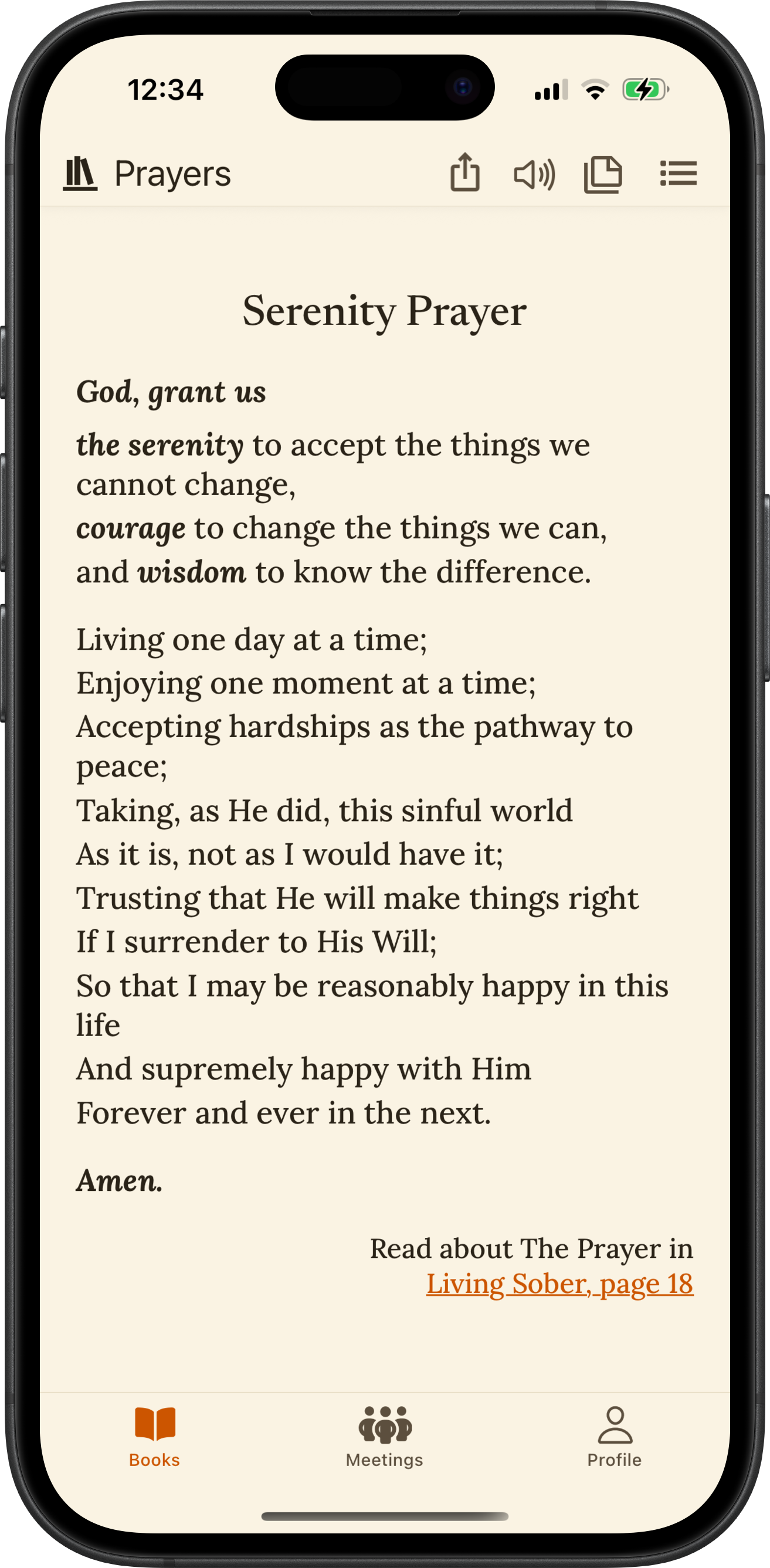
Just as early AA members carried this prayer on small wallet-sized cards, you can carry the entire recovery toolkit in your pocket.
Access the Serenity Prayer, the Big Book, and your daily sobriety tools all in one place. Join the global community on SoberHub.


Free, no-ads on the SoberHub App.
About this prayer
Whether you are newly sober, navigating a difficult moment, or a long-time member of a 12-step fellowship, the Serenity Prayer is a steadying thing to have by heart.
Usually credited to theologian Reinhold Niebuhr and in circulation by the 1930s, the prayer wasn’t originally written for addiction treatment. However, its core message matched the work of getting sober. It breaks down the complexities of life into three parts:
Acknowledging that we cannot control other people, the past, or external circumstances. In recovery, this often means accepting the reality of the addiction itself.
Recognizing what is within our control—our reactions, our daily habits, our willingness to ask for help, and our commitment to working a program.
The clarity that comes from a sober mind, allowing us to pause before reacting and recognize the boundary between what is ours to fix and what is ours to release.
For decades the Serenity Prayer has served as a daily anchor, helping people face anxiety, cravings, and hard days without picking up a drink or a drug.
If you attend an Alcoholics Anonymous (AA), Narcotics Anonymous (NA), or Al-Anon meeting, you are almost guaranteed to hear the Serenity Prayer. It does a few things in the fellowship:
Many meetings open with a moment of silence and the Serenity Prayer to settle the room. Some also join hands to close with it.
Sponsors often advise sponsees to recite the prayer when they are facing a trigger, feeling overwhelmed, or experiencing a craving. It acts as a mental "reset" button.
When a member shares a particularly difficult struggle during a meeting, the group will sometimes recite the prayer together in unison to show solidarity and support.